
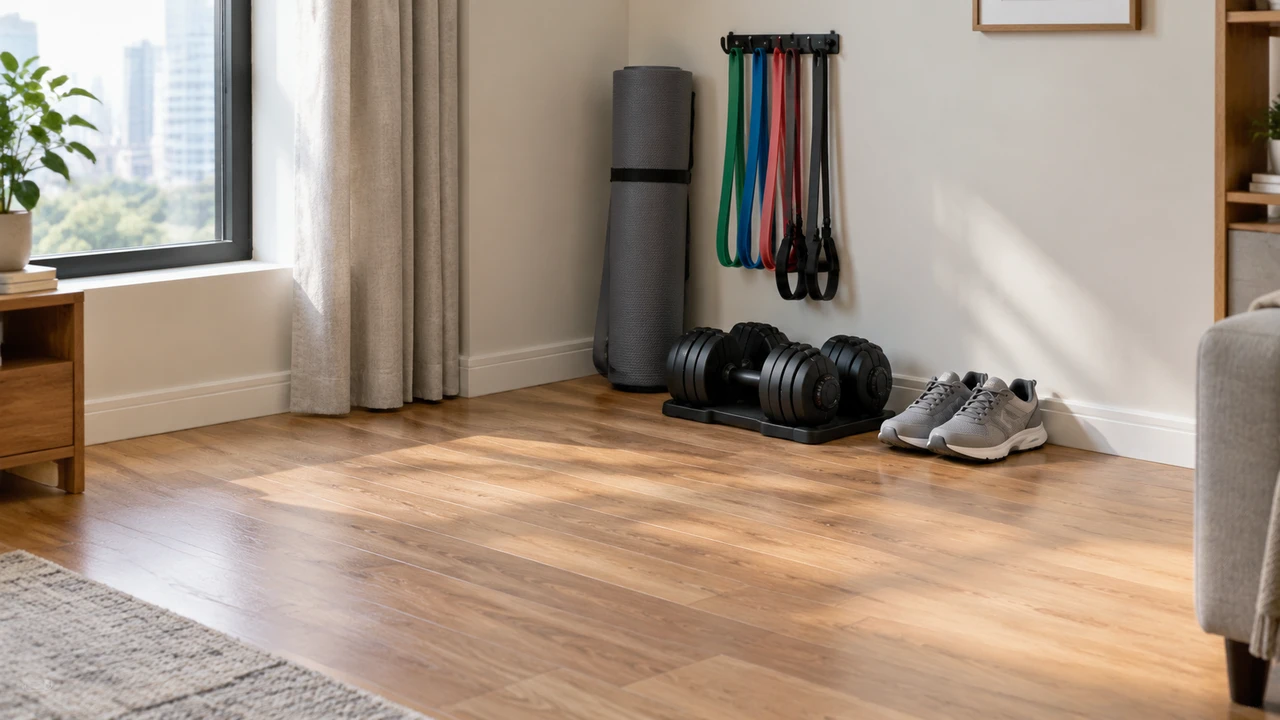
For a beginner home workout in a small space, buy for the routine you can actually fit and repeat—not for a full home gym you may rarely use. Start by measuring your clear floor area, identifying where equipment will be stored, and choosing whether your priority is bodyweight movement, resistance training, cardio, or a mix. A compact setup can begin with one or two versatile items and expand only when your routine shows what is missing.
Start with the space, not the shopping list
Measure the area when it is cleared for exercise, including the usable width and length rather than the entire room. Also check:
- Whether you need to move furniture before each session
- How much vertical and under-bed storage is available
- Whether noise or floor impact matters in an apartment
- Whether the surface is level, hard, carpeted, or slippery
- Whether you need room to lie down, stand, step, or move an implement safely
A product can be compact when stored but require more clearance during use. Adjustable dumbbells, for example, occupy less storage space than several fixed-weight pairs, but you still need enough room to lift and set them down without striking nearby furniture. A resistance band may fit in a drawer, while its usable length can extend well beyond your workout mat.
The four useful starter purchases
| Item | Best first use | Storage footprint | Main advantage | Main trade-off |
|---|---|---|---|---|
| Athletic shoes | Standing, stepping, or impact-based activities | Low | Provides activity-appropriate fit and traction | The right design depends on the activity and floor |
| Resistance bands | Portable resistance and light, flexible setups | Very low | Easy to store and available in different resistance levels | Resistance feel and anchoring options vary |
| Adjustable dumbbells | Strength-focused routines with limited storage | Low to moderate | Multiple loads in one set | Heavier, less compact during use, and adjustment systems differ |
| Floor mat | Floor-based movement and a defined workout surface | Low when rolled | Adds a more consistent, cushioned surface | Thickness, grip, and roll-up size vary |
This is a comparison of equipment functions, not a claim that every model performs the same way. Before buying, verify the manufacturer’s dimensions, weight range, adjustment method, material details, and usage instructions.
Athletic shoes: buy for the activity you will do
Athletic shoes are the first purchase when your routine includes repeated standing movement, stepping, jumping, indoor cardio, or activities that require reliable traction. They are less essential for every floor-based session, particularly if the activity is normally performed barefoot or in socks on a suitable surface.
For a general home setup, compare:
- Fit: Look for enough room to avoid pressure at the toes while keeping the heel secure.
- Traction: Check that the outsole is intended for the surface where you will exercise.
- Stability: A more stable feel may be useful for controlled standing movements, but the ideal design depends on the activity.
- Cushioning: More cushioning is not automatically better; prioritize the feel and support appropriate to your planned use.
- Indoor use: A clean, non-marking outsole can be important for indoor floors.
Shoe descriptions such as “training,” “running,” or “court” indicate a design category, not a guarantee that the shoe suits every workout. Confirm the intended activity, return policy, sizing information, and care instructions before purchase.
Resistance bands: the smallest versatile option
Resistance bands are often the most space-efficient way to add external resistance to a beginner home workout. A set may include several bands with different resistance levels, allowing you to change the challenge without storing multiple bulky weights.
When comparing bands, check:
- The resistance range and how it is measured
- Whether resistance is listed for a particular stretch length
- The band’s length and width
- Whether handles, ankle straps, or a door anchor are included
- Whether the anchor is intended for the type of door and setup you have
- How the bands should be inspected and stored
The label “light,” “medium,” or “heavy” is not standardized across all brands. Treat those labels as product-specific and compare the manufacturer’s information within the same set rather than assuming that “heavy” means the same resistance everywhere.
Resistance bands versus adjustable dumbbells
Choose resistance bands first if storage is your main constraint, you want a portable kit, or you expect to use a range of pulling and pressing movements without keeping weights in the room. Bands can also be useful when you need equipment that packs into a drawer or travel bag.
Choose adjustable dumbbells first if your planned routine is centered on weight-based strength exercises and you want a more familiar, incremental load system. Dumbbells usually offer a clearer physical load, but the smallest and largest settings, adjustment steps, handle design, and storage tray differ by product.
Neither option is universally better. Your decision should depend on the movements you plan to perform, the load range you need, how quickly you want to change resistance, and whether the equipment can be used safely in your available space.
Adjustable dumbbells: more capacity in less storage
Adjustable dumbbells combine multiple weight settings into one pair or set. They can be a practical alternative to buying several fixed-weight pairs, particularly when floor or closet space is limited.
Before purchasing, verify:
- The minimum and maximum weight per dumbbell
- The adjustment increments
- Whether both dumbbells adjust independently
- How the weight is changed
- The total length at lighter and heavier settings
- The required storage tray or clearance
- The manufacturer’s instructions for setting down and handling the dumbbells
A higher maximum weight is not automatically a better choice for a beginner. A set should include a manageable starting setting and useful increments for the activities you expect to perform. Some adjustment mechanisms are faster than others, but speed, durability, and locking behavior are product-specific claims that require verification from the manufacturer or a reliable retailer.
Also consider the shape of the dumbbell at different settings. A long or unusually wide adjustable dumbbell may affect how comfortably it fits beside your body or near furniture, even if its stored footprint is small.
Floor mats: useful surface equipment, not a complete setup
A floor mat can define your workout area and make floor-based movement more comfortable. It may also help separate your equipment from a hard or cold floor, but it should not be treated as a guarantee of impact protection, soundproofing, or injury prevention.
Compare:
- Length and width: Make sure the mat covers the positions you expect to use.
- Thickness: Thicker mats may feel more cushioned but can be less stable for some standing movements.
- Grip: Check both the top and bottom surfaces.
- Material: Confirm whether the material suits your floor and cleaning routine.
- Storage: A foldable mat may store differently from a roll-up mat.
- Cleaning: Review the manufacturer’s care guidance, especially if the mat will be used frequently.
If your exercise area has hard flooring, a mat may be the most useful first purchase for comfort and surface consistency. If you need to protect the floor from heavy weights, look for flooring specifically rated for that purpose rather than assuming a thin exercise mat will provide sufficient protection.
Build a starter kit by available space
For a drawer-sized setup
Start with resistance bands and, if appropriate for your activity, athletic shoes. This combination is easy to store and can support a variety of low-footprint routines. Add a mat if you regularly perform floor-based movements or need a defined surface.
For one clear floor area
A mat plus resistance bands is a sensible space-first combination. The mat establishes the usable area, while the bands add adjustable resistance without requiring a rack, bench, or weight storage system.
For a strength-focused corner
Consider adjustable dumbbells and a mat. Before buying, measure the space needed to pick up, use, and set down the dumbbells—not just the space occupied by their storage tray. Add bands later if you want a lighter, more portable resistance option.
For a mixed routine
Begin with the item that addresses the activity you already intend to do most often. Add shoes for standing or impact-based activity, a mat for floor work, bands for portable resistance, and dumbbells when you need a broader or more substantial load range. Avoid buying all four automatically if one or two will cover your initial routine.
A budget-conscious buying order
A simple purchasing sequence is:
- Buy the activity-specific foundation. This may be athletic shoes if footwear affects fit, traction, or comfort.
- Add the smallest versatile resistance option. Resistance bands usually take less storage space than weights.
- Add a mat if floor comfort or surface consistency is a regular need.
- Move to adjustable dumbbells when your routine requires a clearer load range or bands no longer meet the intended use.
- Only then consider larger items such as benches, cardio machines, racks, or multiple fixed-weight sets.
This order is not a performance ranking. It is a way to limit unused equipment and match spending to demonstrated needs.
Product details to verify before checkout
General buying advice cannot confirm the specifications of a particular model. Check the product page, manual, packaging, or retailer policy for:
- Exact dimensions in storage and in use
- Weight or resistance range
- Adjustment increments and adjustment procedure
- Maximum supported load, where applicable
- Included accessories and required accessories
- Material and cleaning instructions
- Surface compatibility and anchoring instructions
- Warranty, returns, and replacement-part availability
- Current price, stock status, and promotions
Prices and offers can change, so the merchant’s current page and policies govern the purchase. Be cautious with claims about durability, injury prevention, “professional-grade” construction, or superior results unless they are supported by specific documentation relevant to the product.
The short answer
For most small-space beginners, a floor mat and resistance bands form the most compact starting point. Choose athletic shoes when your planned activity depends on footwear, and choose adjustable dumbbells when weight-based strength work is the clear priority. Measure the area first, verify the product’s actual specifications, and add equipment only when your routine identifies a specific need.
Leave a Reply