
Choose a camping sleep system for the coldest nights you realistically expect, then match the sleeping bag and pad before trying to reduce pack weight. A warm bag on an inadequately insulated pad is an unbalanced purchase: the bag’s temperature rating does not describe what it can do independently of the surface beneath you. For recreational camping and weekend backpacking, the goal is compatible insulation, comfortable dimensions, and a packed load you can carry—not the most extreme specifications you can afford.
Start with the trip, not the gear label
Before comparing products, write down four requirements:
- Expected overnight lows: Use conditions at your destination and elevation, not the daytime forecast or temperatures near home. Allow for colder-than-expected nights.
- How you sleep: Note whether you sleep cold, change positions frequently, or need room around your shoulders, hips, and knees.
- How you transport your gear: Car camping allows more weight and bulk; backpacking makes both consequential.
- Which trips the system must cover: Buying for routine summer weekends is different from buying for regular cold-weather camping.
Choose a sleeping bag rated somewhat below the overnight lows you anticipate, as REI’s backpacking bag guidance recommends. That is a starting point, not a guarantee of comfort. The pad, clothing, shelter, weather, and your individual response to cold still affect the result.
If unusually cold trips are only a possibility, consider renting suitable equipment for those trips rather than making every summer outing carry the weight and cost of a winter-oriented setup.
Understand the thermal relationship
Think of the sleeping bag and pad as complementary parts, not interchangeable sources of warmth.
| Component | What its specification helps you judge | What it does not establish |
|---|---|---|
| Sleeping pad | R-value describes resistance to heat transfer toward the ground | A guaranteed comfortable air temperature |
| Sleeping bag | Temperature ratings help compare intended thermal performance under stated conditions | Comfort regardless of the pad underneath |
| Combined system | Whether the insulation above and below you suits the trip | A universal temperature rating obtained by combining the two numbers |
Sleeping bag temperature ratings assume a sleep setup that includes an insulating pad. MEC’s guidance also notes clothing assumptions, including long underwear. Consequently, a bag’s advertised number is not a promise that the bag alone will keep every sleeper comfortable at that temperature.
Do not add R-value to a bag’s temperature rating or convert it into “extra degrees.” They describe different properties. A higher-R pad can address inadequate insulation underneath you, but it does not change the bag’s documented rating.
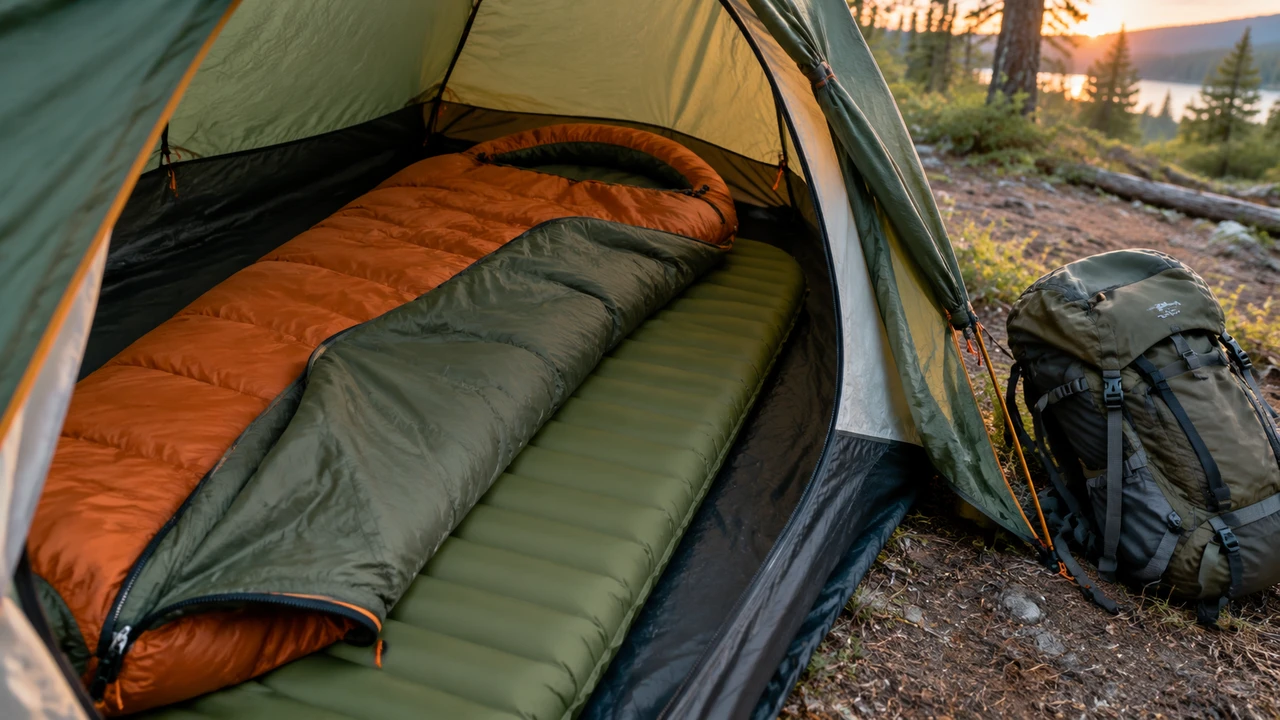
Choose a pad’s insulation before choosing its weight
Sleeping pad R-value measures thermal resistance: higher values indicate greater resistance to heat transfer. It is an insulation specification, not a cushioning score.
REI’s published guidance groups pads into these broad categories:
| Sleeping pad R-value | Broad use category |
|---|---|
| Below 2.0 | Warm weather |
| 2.0–3.9 | Cool weather |
| 4.0–5.4 | Cold weather |
| 5.5 and above | The higher-insulation end of the range |
Use these bands to narrow your search, not to assign an exact overnight temperature to a pad. Ground conditions, the rest of your equipment, and your own warmth needs prevent a simple one-to-one conversion.
For a summer-only camper, paying for very high insulation may solve a problem their trips rarely present. For someone who routinely encounters cold nights, choosing a low-R pad solely because it is light creates a mismatch even if the sleeping bag looks sufficiently warm on paper.
Separate insulation from comfort
Evaluate the pad in two passes:
- Does its insulation suit the intended conditions?
- Do its dimensions and cushioning suit your body and sleeping position?
For side sleeping, check whether your hips and shoulders feel adequately supported. For back sleeping, check whether your arms remain comfortably supported. If you turn frequently, try those movements rather than judging the pad while lying motionless.
A thick-looking pad is not automatically a warm pad. Likewise, adequate R-value does not establish whether a narrow or short pad will feel comfortable to you. Inspect the insulation specification and the usable dimensions separately.
Read beyond the sleeping bag’s headline number
An advertised sleeping bag temperature rating is useful only when you understand what the number represents.
Before buying, check:
- Whether the specifications identify an EN or ISO test rating.
- Whether the advertised temperature is labeled comfort, limit, or something else.
- Whether competing bags are being compared using the same rating category.
- Whether the manufacturer explains the intended use and test assumptions.
REI identifies EN and ISO laboratory ratings as useful for comparing sleeping bags. However, not every bag or quilt has an independently tested rating. A number in a product name is therefore not enough evidence to treat two products as equivalent.
For comfort-focused recreational camping, give particular attention to the published comfort rating when available. Do not assume an advertised limit number is a comfort promise. If the listing does not explain its rating, seek clarification before making it the basis of a cold-weather purchase.
An illustrative buying decision
Suppose your planned overnight lows are around 40°F (4°C).
Start by looking for a bag with an appropriate published rating somewhat below that expected low. Then check what kind of rating it is and whether the pad is intended for the conditions you expect.
A bag advertised at 30°F (−1°C) paired with a warm-weather pad should not automatically become a “30-degree system” in your planning. That pairing has not established adequate ground insulation. Equally, a highly insulated pad does not make an otherwise unsuitable bag sufficient.
The useful question is not “Which component has the most impressive number?” It is “Have I addressed both the bag’s warmth and the pad’s ground insulation?”
Reduce pack weight without undermining the system
Once the insulation and fit requirements are met, compare the weight and packed volume of the complete backpacking sleep setup.
Include:
- The bag or quilt in the size you need.
- The pad in the length and width you will actually use.
- Required inflation equipment.
- Stuff sacks, repair supplies, and other accessories you intend to carry.
Compare equivalent sizes. The listed weight of a regular pad does not describe the long-wide version you may need.
| Buying choice | Potential advantage | Trade-off to examine |
|---|---|---|
| Narrower or shorter pad | May reduce carried weight and bulk | Less supported space as you move |
| More spacious bag | More room for your preferred position | Check the weight and packed-volume difference |
| Higher-R pad | More ground insulation | Compare actual weight, bulk, and cost rather than assuming |
| Warmer-rated bag | More allowance for colder trips | May be unnecessary for your usual conditions |
| Lightweight premium setup | Can reduce carrying demands | Higher cost may not matter for short approaches or car camping |
A useful shopping comparison is between complete combinations, not isolated products. One pairing may have a lighter bag but a heavier pad; another may reverse that balance. Total weight and usable comfort matter more than which individual item wins a specification contest.
Spend money on the weakest part first
If you already own some equipment, identify the mismatch before replacing everything.
- Your bag appears suitable, but the pad is intended for warm weather: Investigate pad insulation before buying a much colder-rated bag.
- Your pad suits the conditions, but the bag’s rating does not: Prioritize the bag rather than assuming more pad insulation will compensate.
- Both have appropriate specifications, but you cannot sleep comfortably: Reassess dimensions, sleeping position, and the rating assumptions—not just warmth.
- You mostly car camp: Favor appropriate insulation and comfortable space over paying a premium for small weight reductions.
- You backpack regularly: Compare total carried weight and packed dimensions after establishing minimum insulation and fit requirements.
Avoid buying maximum warmth “just in case” without identifying the trips that need it. A system designed around your regular use, with a separate plan for occasional colder outings, can be a more practical purchase.
Check the pairing before committing
Before removing tags or heading out, confirm that the actual sizes work together:
- Can you lie in your usual position inside the bag?
- Can you turn without repeatedly moving off the pad?
- Does the pad fit your shelter’s usable floor space?
- Does the complete setup fit your pack or vehicle storage?
- Are the published ratings clear enough to support your intended use?
A home trial is useful for assessing space, movement, and setup, but it does not validate cold-weather performance. For an unfamiliar combination, choose an initial outing in mild conditions with a straightforward backup plan.
The best purchase is a balanced camping sleep system: a pad chosen for ground insulation, a bag chosen using clearly identified temperature ratings, and dimensions that let you sleep normally. Optimize weight and price within those requirements—not by removing the component that makes the rest of the system work.
Leave a Reply